Specialized in the sale of robotic products! educational robots, toy robots, connected objects
- Home > News > Educational robots > Microduck: the tiny robot duck that learns its own tricks
Microduck: the tiny robot duck that learns its own tricks
Educational robots
It stands 25 centimetres tall, fits in one hand, and has the face of a duck. Yet behind its toy-like appearance, the Microduck hides one of the most interesting approaches we've seen in consumer robotics for a while. This isn't just a remote-controlled gadget. It's a robot you train yourself, using the same methods found in AI research labs.
Developed by Pollen Robotics, a French team now part of Hugging Face, the Microduck comes with a rare promise: fun straight out of the box, yet open enough that you can teach it entirely new behaviours yourself. Here's why this little duck deserves a closer look.
🦆 Want to know more about the Microduck?
Our team can tell you everything about this robot and help you with any order or pre-order.
✉️ contact@robot-advance.com
📞 +33 4 37 47 91 45
Contact us →A biped robot that walks, grabs and gets back up on its own
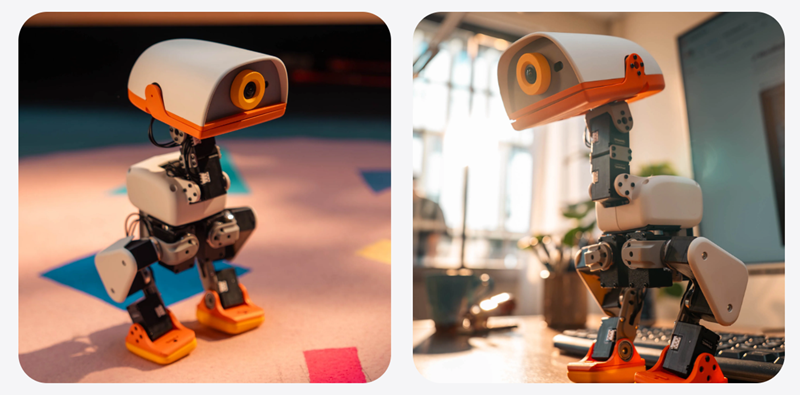
Let's start with the concrete. The Microduck is a two-legged robot fitted with fifteen motors, a wide-angle camera, a compact LiDAR sensor and two inertial measurement units. In plain terms: it can move around, sense its environment and keep its balance like a real little creature. Its articulated beak even lets it pick up objects.
Seven behaviours come pre-installed out of the box. It walks at a set speed, sits down and stands back up on its own, throws a kick, scoops objects off the ground with its beak, roller skates when you fit its skates, and above all, it gets back on its feet by itself when it falls onto its back. That last point may seem trivial, but it's actually a real technical feat: a biped robot that stands back up unaided is the kind of thing that takes months of work in a lab.
Everything runs on an onboard control loop at 50 Hz, giving it fluid movements and a solid ability to recover its balance when nudged. At 780 grams, it's easy to handle, and a game controller is included to pilot it directly.
The real novelty: you teach it its own tricks
This is where the Microduck truly sets itself apart from anything else on the playful robot market. Each of the robot's behaviours isn't set in stone. It's a "policy", a model you can retrain on your own machine.
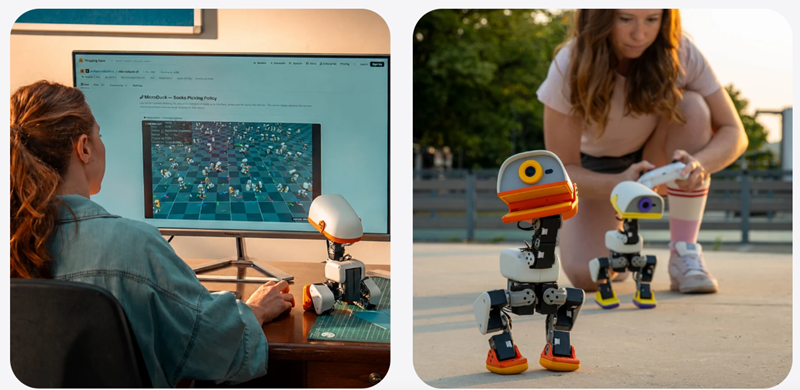
The principle relies on a technique called reinforcement learning, the same one that allowed AI to beat the best Go players or pilot complex systems. In practice, the process unfolds in four stages. First you train a behaviour in a physics simulation, on your own computer or on Hugging Face's servers. Then you deploy that behaviour onto the real robot, in a single step. You tune the simulation, retrain, redeploy. And finally, you can publish your new behaviour to share it with the community.
This approach, known as "sim2real", training in simulation then transferring to the real world, sits at the heart of current robotics research. Seeing it arrive in a product at this price, in anyone's hands, is genuinely new.
Fully open source, from the code to the motors
The Microduck isn't just open on paper. Its entire software stack is available on GitHub under the Apache 2.0 licence, one of the most permissive there is. The SDK, the simulation, and above all the full reinforcement learning training system are accessible. What the robot runs is exactly what you can read, modify and retrain.
The simulation is built on MuJoCo, a physics engine recognised and used in research worldwide. The seven behaviours it ships with are all published and retrainable. On the hardware side, the robot runs a Rockchip RK3566 processor with an AI accelerator, 1 GB of RAM and 32 GB of storage, all connected via Wi-Fi and Bluetooth. For anyone wanting to learn modern robotics or experiment with embedded AI, it's hard to find a better playground. Nothing is hidden, nothing is locked.
This philosophy of openness comes with a genuinely active community on Discord, where users share their creations, swap behaviours and lend a hand when a leg starts misbehaving.
Four colourways, one single brain
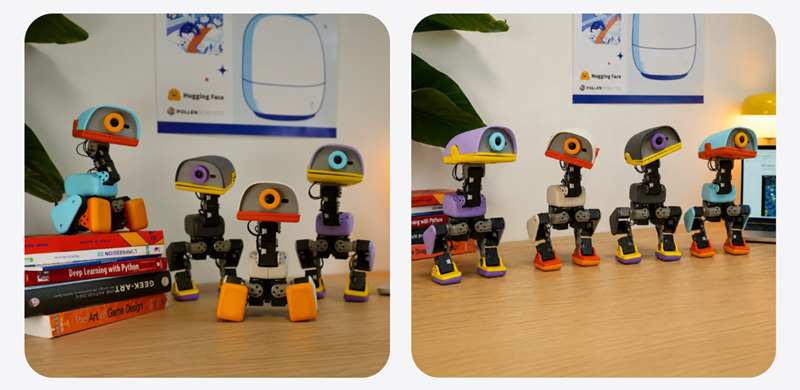
On the aesthetic side, the Microduck comes in four colourways: cream, graphite, lavender and sky blue. The choice is purely a matter of taste, since the brain stays identical from one model to the next. Pick the shell you like, the capabilities are the same.
The robot ships with everything you need to get started: the removable battery, the USB-C cable and the game controller are all in the box. Expect around an hour of battery life, with the ability to swap the battery on the fly. Several add-on packs enrich the experience. A charger pack adds a dual charger and spare batteries so you never run flat. An accessory pack brings the roller skates, a ball, a laser pointer and NFC tags to trigger actions. And for those who really want to get their hands dirty, a dev pack provides spare motors, cables, a screwdriver and everything needed to tinker with the robot in depth.
Who is the Microduck for?
This little robot speaks to several profiles. Tech enthusiasts will find a fascinating object that does impressive things right out of the box. Makers and tinkerers will have months of fun with the open, modifiable side. Students and teachers in computing or robotics will have a concrete tool for understanding reinforcement learning, without needing a 70,000-euro laboratory.
It naturally finds its place alongside our other educational and programmable robots for anyone wanting to go beyond the basics and get a real taste of research robotics. It's also, quite simply, a pleasant object to have on your desk. It walks, it grabs, it stands back up, it roller skates. There's something endearing about this little mechanical duck that makes you want to watch it move, even when you're not coding.
Pollen Robotics, the French gem that became Hugging Face's robotics arm
You can't talk about the Microduck without mentioning the team that designed it. Pollen Robotics is a company founded in 2016 in Bordeaux by Matthieu Lapeyre and Pierre Rouanet, two former researchers from Inria's Flowers team. From the outset, their conviction was simple: robots will play a profound role in our lives as the interface between artificial intelligence and the physical world, and that future must be open source.
The brand first made its name with Reachy, an open-source humanoid robot designed for research and education, now used by prestigious institutions such as Cornell and Carnegie Mellon universities. This work eventually caught the attention of a heavyweight in artificial intelligence. In April 2025, Hugging Face, the go-to platform for open-source machine learning, acquired Pollen Robotics to fold its hardware expertise into its software ecosystem.
This union perfectly explains the Microduck's DNA. You'll find Hugging Face's philosophy of total openness, the ability to train on cloud servers, and the ambition to put tools usually reserved for laboratories into everyone's hands. The Microduck isn't a mere gadget: it's a mainstream gateway to the intelligent robotics of tomorrow, carried by a team that knows exactly what it's doing.
To summarise
The Microduck pulls off a difficult balance. It's fun immediately, with no complex setup, while offering a technical depth rarely seen for those who want to go further. A complete biped robot, able to walk, grab and stand back up on its own, fully open source, and built so you can teach it new tricks using the real methods of AI research.
Behind this little duck lies a clear vision of what robotics should be: open, accessible and in everyone's hands. Whether you're a tech enthusiast, a tinkerer, a teacher or simply curious, the Microduck has plenty to keep you busy well beyond the first discovery.
Interested in the Microduck?
Order, pre-order or just a question: our team is here to help.
✉️ contact@robot-advance.com
📞 +33 4 37 47 91 45
Get in touch →